
February Newsletter—Are Your Energy Costs Crazy Too?!
Happy Black History Month!
We’d like to start this newsletter by highlighting the work of Hazel O’Leary, a Black pioneer in electric innovation who was a strong advocate for energy efficiency and renewable energy. As a child, she attended a segregated school in Virginia before her parents sent her to New Jersey in hopes that she would receive a better education. She later became a distinguished lawyer, esteemed public servant, and university administrator.
In 1993, she became the first woman and African American to serve as the U.S. Secretary of Energy. Through this role, Hazel initiated an aggressive clean-up program, created an Openness Advisory Panel, and encouraged the Clinton Administration to end nuclear testing in the United States. She gained the support of minority communities and helped lead a community of Native Americans who owned energy-producing lands to have a higher-profile presence in federal energy affairs.
O’Leary’s work drove the commercialization of energy-efficient technologies through partnerships with nonprofits and manufactures. She also advocated and helped secure funding for clean energy research and development. As a result, many clean energy successes in the United States can be traced back to Hazel O’Leary’s legacy—including our work at Kicking Gas!
Subsidies Remain Open!
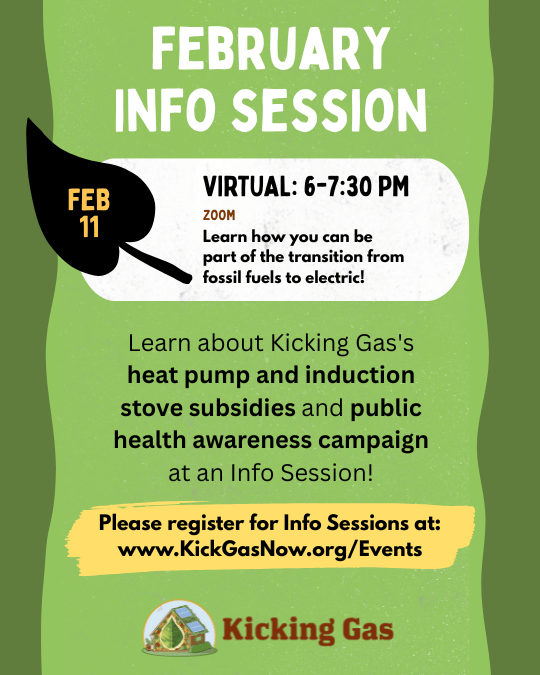
For those residing in Island or Snohomish Counties, we still have heat pump and cooking subsidies available. Our next virtual Info Session will be held tomorrow, February 11th, from 6:00 - 7:30 PM. Register for this event here. Completing an Info Session is a requirement for our program, so be sure you attend if you haven’t already!
Collaborating with LETI
We held our first Info Session for Spanish speakers at the end of January! Thanks to the incredible support of our community, Kicking Gas has grown to include multiple bilingual team members. This has allowed us to expand our program to more communities, including those who speak Spanish. Not only does this increase our work to decarbonize our neighborhoods even more accessible, but it deepens our connection with residents in communities throughout the region.
This past Info Session was held in collaboration with the Latino Educational Training Institute (LETI), a nonprofit empowering self-sufficiency for Latino immigrants and low-income individuals. LETI provides information and resources for supporting and uplifting immigrant individuals to realize their full educational and employment potential, despite the overwhelming disparities and inequities they face daily. We’re proud to offer Info Sessions at LETI and partner with their team to support our communities in the future.
If you or someone you know is interested in joining an Info Session for Spanish speakers, please check our Events page for future sessions!
Energy Prices Continue to Rise
According to an article in Pierce County’s The News Tribune, rates for Puget Sound Energy (PSE) customers went up again January 1, with about a 12% hike for electric and 7% increase for natural gas customers. This is the second year in a row that PSE has raised its rates and customers are noticing!
PSE is eyeing yet another increase in its rates, which would go into effect in February or March of 2027. Matt Steuerwalt, PSE’s senior vice president of external affairs, said PSE will file for that rate increase with the UTC “in the next month or two.” One of the biggest reasons for the upcoming increase, Steuerwalt said, is inflation and increasing demand (**cough**, can we say tariffs and data centers?).
Steurwalt did say that PSE has resources for residents who are struggling. These include budget programs and payment plans. Residents can call the customer call center 1-888-255-7733 or visit pse.com/gethelp. PSE also has energy advisors that customers can speak to for personalized assistance. To speak to an energy advisor, call 1-800-562-1482 or visit pse.com/en/rebates/ask-advisor-form.
Read more information in Pierce County’s The News Tribune here.
At Kicking Gas, we wonder if this way that Steurwalt has narrated the story paints the entire picture. As more and more people switch to electric, we are seeing bills increase. We wonder how connected that is to PSE making less of a profit, since there is more money for large corporations to be made via coal and other fossil fuels because of how unsustainable they are. In fact, the Trump administration is illegally forcing Washington’s last coal plant to keep burning coal under a false energy emergency order.
The costs to pay for the continued operation of the unnecessary coal unit will likely be paid by PSE’s billpayers. This doesn’t seem fair when we, the billpayers, are already doing so much to make our energy use more efficient. What can we do to collectively make sure our communities’ work to switch to energy-efficient and more sustainable appliances is supported and not exploited? Keep reading for a few ideas, and reply to this email if you have more ideas.
Take action!
The Coal Act, Senate bill 5439, is currently being reviewed. Please comment to your legislatorsin support of divestment of funds under management by the state investment board from thermal coal. Though the Coal Act doesn’t directly fund Kicking Gas, taking this action would help to better protect our public dollars and our planet, shifting away capital from extractive industries and financial systems.
Though energy prices are surging, ductless heat pumps are still the most energy-efficient HVAC systems for residential heating and cooling. If you haven’t yet, and are considering making the switch, please register to attend our Info Session tomorrow to learn more.Here’s a few reminders on how to utilize your ductless heat pump most efficiently: 1. Set it and forget it: You may be accustomed to turning the heat up and down based on your daily schedule. For heat pumps, it’s actually most efficient when maintaining a set temperature! If you’re away from home for an extended period of time (more than a few days), you can turn it down somewhat. Heat pumps actually use more energy when ramping to a higher temperature than they do keeping a room consistent. Therefore, fluctuating the output isn’t ideal.
2. Use the highest fan speed you’re comfortable with: A heat pump works most efficiently when set to a higher fan speed! Of course, high fan speeds can produce more ambient noise and air movement. Use the highest speed you’re comfortable with, then dial in your preferred temperature setting.
3. DON’T use auto-mode: It’s natural to think “AUTO” mode would be a more efficient and convenient setting. But if you use it, your unit runs the risk of toggling unnecessarily between heating and cooling, especially during the spring and fall seasons, which wastes energy and can make your home uncomfortable. Your heat pump will run most efficiently when set to “HEAT” in winter and “COOL” in summer.
Sustainable Connections is Hiring
Sustainable Connections, a Bellingham based nonprofit organization similar to ours, is looking to hire a Commercial Energy Advisor position on the Energy & Green Building Team!
Primary responsibilities include conducting on-site commercial energy audits, developing practical recommendations, and supporting clients in implementing energy efficiency and electrification improvements, with a focus on working with high-needs communities in Northwestern Washington, including Latino, rural, and tribal communities, as well as nonprofits and community-serving organizations.
Find more information and apply here.